
You did the research. Monitor at eye level, lumbar support cushion, a reminder app that pings you to stand every hour. For a week or two it seemed to help. Then the same tightness crept back into your neck and shoulders by mid afternoon, and the ache settled into your lower back by the end of a long day exactly like it always has. It is tempting to conclude you did the ergonomics wrong, or that you need an even better chair. Often, though, the setup was never the whole problem to begin with.
What Ergonomic Advice Gets Right
None of the standard advice is wrong. Posture, monitor height, and the load your spine carries through a workday genuinely matter, and small adjustments to how you sit, stand, and move add up over months. Leaning toward a screen or tipping your head down at a phone puts real, measurable load on the neck and back, and repeated hour after hour, that load does contribute to pain. Ergonomic changes are worth making. They are just often treated as the entire solution when they are really only part of one.
What Ergonomics Cannot Reach
A chair adjustment addresses the mechanical load on your spine in the moment you are sitting in it. It does nothing for a nervous system that has already learned to hold tension in the neck and shoulders as a baseline habit, built up over months or years of stress, old injuries, and repeated strain. That kind of tension does not reset just because the chair changed. It shows up again the moment your attention drifts back to work, regardless of how well the desk is set up underneath you.
Your spine houses the spinal cord, and nerves branch out from it to tissue throughout the body. A misalignment or ongoing tension pattern can interfere with that communication in ways that go beyond where you feel the ache. That is part of why patients dealing with chronic neck and back pain often mention digestive symptoms too, since many of the same spinal segments carrying tension also serve digestive function. A better chair does not touch that layer of the problem at all.
Why It Comes Back by Afternoon
Stretching and a heating pad bring real relief, and that relief is genuine, not imagined. What it usually cannot do is change the underlying pattern your nervous system has settled into. Think of chronic tension as a habit the nervous system has learned, not just a muscle that is tired. A stretch loosens the muscle for an hour. It does not retrain the pattern underneath that keeps pulling it tight again once the stretch wears off, which is exactly why the same spot tightens back up by the time you get home.
Where the Pattern Actually Shifts
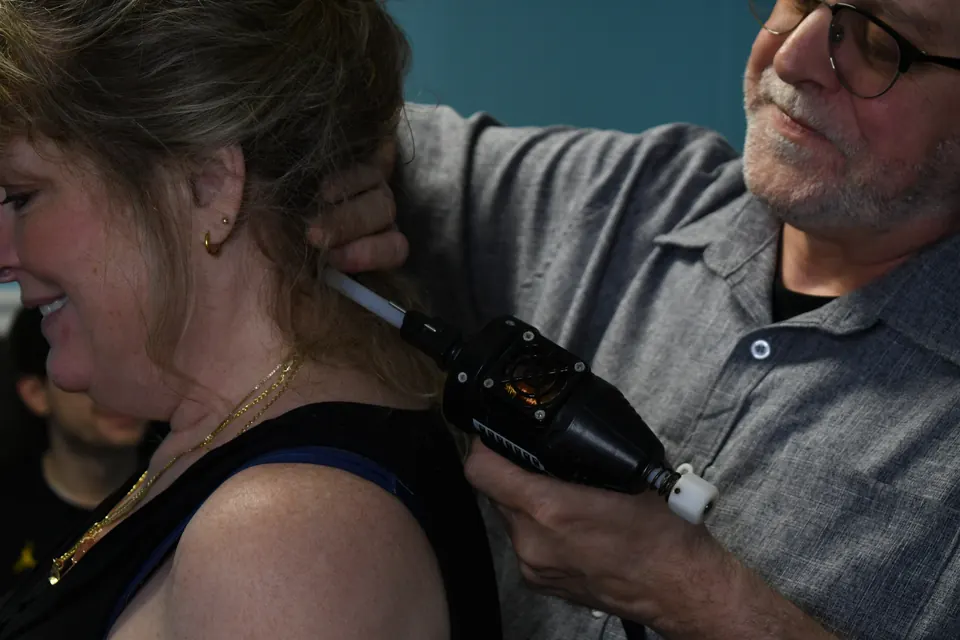
Our doctors start with a thorough history and INSiGHT scanning that measures thermal, heart rate variability, and sEMG patterns in your nervous system, so we can see objectively where stress has become stuck, whether from posture habits, an old injury, or accumulated everyday strain, rather than guessing from wherever happens to hurt most that week. Using Koren Specific Technique and Talsky Tonal Chiropractic, our doctors make light, nervous system focused corrections with no cracking, popping, or twisting. Because these techniques can be applied in nearly any position, care can be adapted to the exact posture that tends to trigger your pain, whether that is sitting at a desk, bending toward a screen, or turning to check a blind spot while driving.
What Tends to Change Alongside the Desk Setup
Pairing a better setup with care aimed at the nervous system pattern underneath tends to produce results that ergonomics alone rarely reach on their own:
- Tension that eases through the afternoon instead of building steadily until quitting time
- Fewer flare ups tied to long meetings or heavy screen days
- Better sleep, since a nervous system that is not bracing all day tends to settle more easily at night
- Improved digestion for patients who had also been dealing with reflux or irregular bowel movements
- Posture that starts to feel natural rather than something you have to consciously correct all day
It Often Starts Younger Than You Think
Picture an adult with desk pain and you probably do not picture a teenager. We are seeing this pattern earlier now than a generation ago, and screens are a big part of why. Kids carrying backpacks loaded past a comfortable weight, spending hours a day looking down at a phone or tablet, and sitting through longer stretches of remote schoolwork are developing the same forward head posture and tight upper back pattern that used to show up mainly in adults with decades of desk work behind them. The nervous system piece underneath the pain works the same way at any age, which is one more reason addressing the pattern early, not just the setup, matters.
Bringing Both Pieces Together
Keep the raised monitor and the supportive chair. Those changes reduce the load your spine carries every single day, and that matters. Just do not expect them to undo a pattern your nervous system has been holding for years on their own. Addressing both the setup and the underlying pattern together tends to bring relief that actually holds past the first good week.
Our doctors see patients on Saturdays in Royal Oak and would be glad to look at what is actually driving your neck and back tension. Learn more about our approach to back and neck pain, or get our free guide on the nervous system side of chronic tension. You can book online, or call us at (248) 616-0900 to talk through what you have already tried.