
You have had your ears checked. The audiologist ran the tests, your hearing came back fine, and there was no infection or fluid to explain the fullness, the ringing, or the strange muffled feeling that comes and goes. You were told everything looks normal and sent on your way, which is somehow more frustrating than if they had found something. Meanwhile the sensation keeps showing up, sometimes alongside a jaw that clicks when you chew or aches by the end of the day.
If that combination sounds familiar, you are not imagining a connection. The joint that moves your jaw sits directly in front of your ear canal, close enough that irritation in one area regularly shows up as symptoms in the other.
How the Overlap Shows Up
Patients describe this combination in a lot of different ways: a sense of fullness or pressure in one ear that seems to shift with jaw movement, ringing that gets louder during a stressful or clenching-heavy day, or a dull ache around the ear that is easy to mistake for an ear infection. Some notice mild dizziness or a feeling of being slightly off balance, especially after a long day of chewing or talking. Jaw clicking, popping, or a limited ability to open fully often rides alongside these ear complaints rather than showing up on its own, and the two tend to flare and settle together rather than on separate timelines.
Why the Jaw and the Ear Are So Closely Linked
The temporomandibular joint sits just in front of the ear canal, sharing nerve and muscle connections with structures inside and around the ear. When the jaw joint is under strain, whether from clenching, an old injury, or tension carried in the muscles around it, that strain does not always stay contained to the joint itself. It can refer discomfort, pressure, and even a sense of altered hearing into the ear, without anything actually being wrong with the ear.
Why the Nervous System Ties the Two Together
The trigeminal nerve, the largest cranial nerve in the body, is the main nerve controlling the jaw, and it processes sensation across the face, temple, and areas near the ear as well. When tension builds in the upper cervical spine, right where the trigeminal nerve's processing center sits in the brainstem, that system can run hot, and sensations from the jaw and the structures near the ear can become harder for the brain to tell apart. That overlap is part of why jaw tension so often gets misread as an ear problem, and why an audiologist who is specifically looking at the ear itself may not find anything wrong there.
Why an Ear Exam Alone Often Comes Back Clean
An ear exam is built to look for infection, fluid, wax buildup, or structural problems within the ear itself, and it is very good at ruling those things out. What it is not built to evaluate is tension in the jaw joint just in front of it, or strain in the upper cervical spine feeding into the same nerve pathways. That is a genuinely different system, evaluated a different way, which is part of why a completely normal ear exam and a real, persistent symptom can both be true at the same time.
Our Approach at Van Every
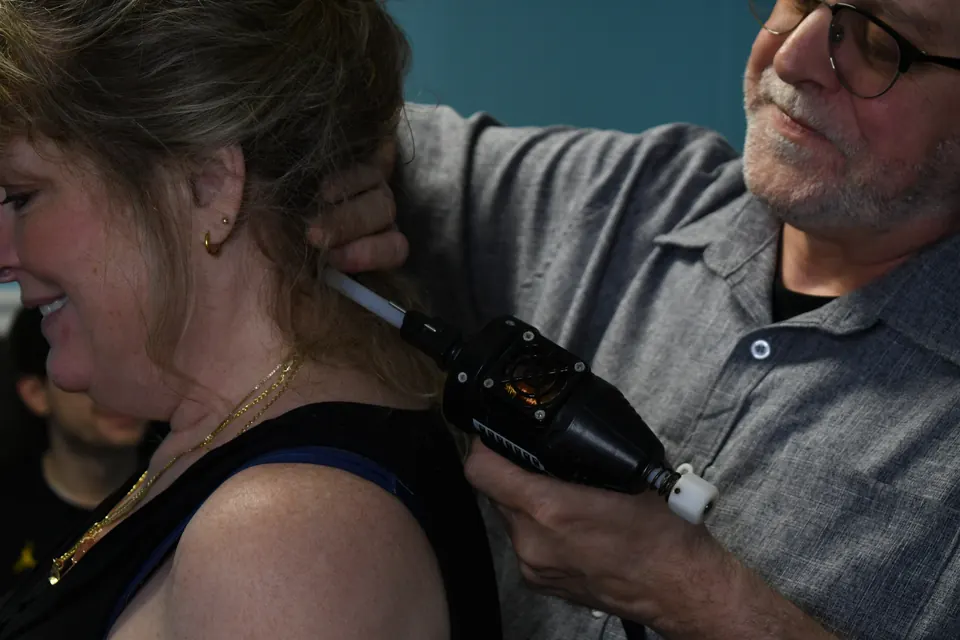
We start with a thorough evaluation, including INSiGHT scanning, thermal, heart rate variability, and sEMG, to see objectively where tension has been sitting from old injuries, clenching habits, or accumulated stress. We evaluate the jaw joint together with your cervical alignment and head posture, since the two are rarely acting independently. Using Koren Specific Technique (KST) and Talsky Tonal Chiropractic (TTC), our doctors apply light, nervous system-focused contacts at the upper cervical spine and, when useful, right at the jaw, with no cracking or twisting anywhere in the process.
What Patients Often Notice
Patients who came in mainly for jaw pain often mention, almost as an aside, that the ear fullness or ringing they had stopped expecting anyone to explain has eased alongside it. Less clicking and popping tends to come first, followed by an easier time opening the mouth fully and less pain when chewing. Many notice the ear pressure lifting on the same side as their jaw tension, along with fewer temple headaches and an easier time falling asleep. Because the jaw and ear symptoms tend to track together, a lot of patients find that addressing one genuinely helps the other. Sleep often improves too, since a jaw that has finally stopped bracing overnight is one less source of interruption, and several patients tell us they had simply stopped expecting anyone to connect the two symptoms before their first visit here.
A Few Things That Can Help Between Visits
- Notice whether the ear symptom worsens with chewing, yawning, or talking, since that pattern points toward the jaw rather than the ear itself
- Give your jaw a break from gum and other chewy foods during a flare
- Pay attention to whether clenching gets worse during stressful stretches of the day
- Ask your dentist about a night guard if grinding is part of your pattern
- Keep a simple note of when the ear fullness or ringing shows up, since patterns are often easier to see in writing than memory
Taking the Next Step
If ear symptoms and jaw tension have been showing up together with no clear explanation, our doctors in Royal Oak would be glad to look at the whole picture with you. Learn more on our TMJ and jaw pain page or download our free guide on the jaw-neck connection. Ready to talk it through? Book online with our doctors or call us at (248) 616-0900.