
You catch yourself in a store window or a photo someone else took, and there it is: shoulders rounded forward, head hanging out ahead of the rest of you. You pull it back for a minute. Sit up straight, you tell yourself, the way you have been told your whole life. Five minutes later you are back on your phone and your body has already slid right back to where it was.
You have tried the posture corrector brace. The standing desk. The phone reminders every hour. A few weeks of neck stretches every morning. Each one helped a little, for a while, and then the same slouch crept back in. If that sounds familiar, it helps to know this was never really a discipline problem.
Your posture is not a choice your muscles make on their own. It is a pattern your nervous system is running, often without your permission, and it takes more than willpower to change a pattern that has been running in the background for years.
What Tech Neck Actually Does to Your Body
In a normal spine, the ear lines up roughly over the shoulder. A head weighs somewhere around 10 to 12 pounds in that position. For every inch it drifts forward, it behaves like it gained about 10 more pounds for the neck and shoulders to carry. Tilt your head to the roughly 60-degree angle most people use to read a text, and that same head can feel like it weighs close to 60 pounds.
Left there long enough, it rarely stays confined to the neck. Most people notice a dull ache or stiffness across the cervical spine first, then tension headaches that seem to come out of nowhere. Rounded shoulders bring their own tightness through the chest and weakness through the upper back, and pain often settles in stubbornly between the shoulder blades. Some feel numbness or tingling running down an arm as nerves get compressed. Others just feel tired, worn down by the extra energy it takes to hold a forward-leaning head up all day, or notice they are not catching full breaths because a collapsed chest limits how much the ribs can expand.
The Nervous System Behind the Slouch
Your brain continuously coordinates position sense from the spine, joints, and inner ear with the muscle commands that hold you upright. When the nervous system has been running a chronic stress response, it tends to generate a very specific posture: flexion. Shoulders forward, head forward, upper back curled inward, the same protective curl most mammals fall into under threat.
Picture it as one part of the nervous system having the gas pedal stuck on, keeping those muscles braced in a guarded position long after the original stressor is gone. When the upper cervical joints stay locked forward like that, they also send distorted signals to the brain about where the head actually is, so the body never quite registers how far forward things have drifted and never triggers its own correction. Willpower cannot easily override a signal that has been running for years, but when the signal itself changes, the posture tends to follow.
Why Braces, Stretching, and Standing Desks Only Get You So Far
None of those approaches are wrong, and many people get real, partial benefit from them. A posture brace holds you upright while you are wearing it. An ergonomic setup reduces load during the workday. Stretching loosens what is tight in the moment. What none of them do is change the underlying nervous system pattern telling those muscles to hold that forward position in the first place, which is exactly why the posture returns once the brace comes off or the workday ends.
How We Approach Posture and Tech Neck
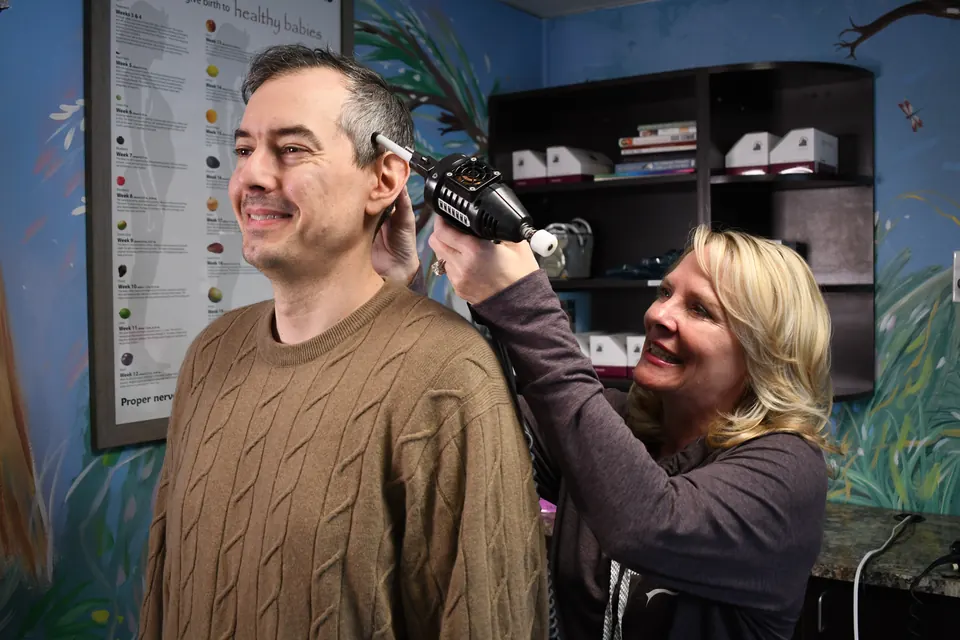
We start with a posture assessment alongside a gentle INSiGHT scan, thermal, heart rate variability, and muscle (sEMG) readings, so you can see the strain on your nervous system in real terms rather than just feeling it. From there, our doctors use Koren Specific Technique (KST) and Talsky Tonal Chiropractic (TTC), gentle, nervous system-focused care with no cracking, popping, or twisting, applied to the upper cervical and thoracic areas where that protective pattern tends to concentrate. We can even work with you in the exact posture that tends to trigger your symptoms, since the tension pattern that tech neck creates is often position-dependent.
What Patients Often Notice
Improving posture often clears up problems people did not connect to it in the first place. Many patients tell us headaches, brain fog, and shoulder tension ease alongside the neck and upper back pain. Breathing often gets easier as the chest opens back up, and energy tends to improve once the body is not working so hard just to hold the head up all day. Some notice other people mentioning the change, standing taller, looking more relaxed, before they fully feel it themselves. We build your plan around what your own scans and history show, not a generic protocol.
Habits Worth Building Alongside Care
Correction rarely lasts without changing the habits that caused it in the first place. A few that matter:
- Hold your phone at eye level instead of tilting your head down to read it.
- Set your monitor at eye height so you are not looking down at a screen for hours at a time.
- Use a laptop stand or riser so your arms and shoulders can relax rather than hunch.
- Take a short break every 15 to 20 minutes if you are on a device for long stretches.
- Try a few slow, gentle side-to-side neck stretches after a warm shower, when muscles are already relaxed.
Next Steps
If any of this sounds like the last few years of your posture, our posture and tech neck page walks through how our doctors evaluate and work with this pattern. You can also download our free guide on why posture is a nervous system issue before your first visit. Ready to see what your posture is really costing you? You can book online or call our Royal Oak office at (248) 616-0900. The instruction to sit up straight was aimed at the wrong target. The pattern lives in the nervous system, and that is where it has to be addressed.