
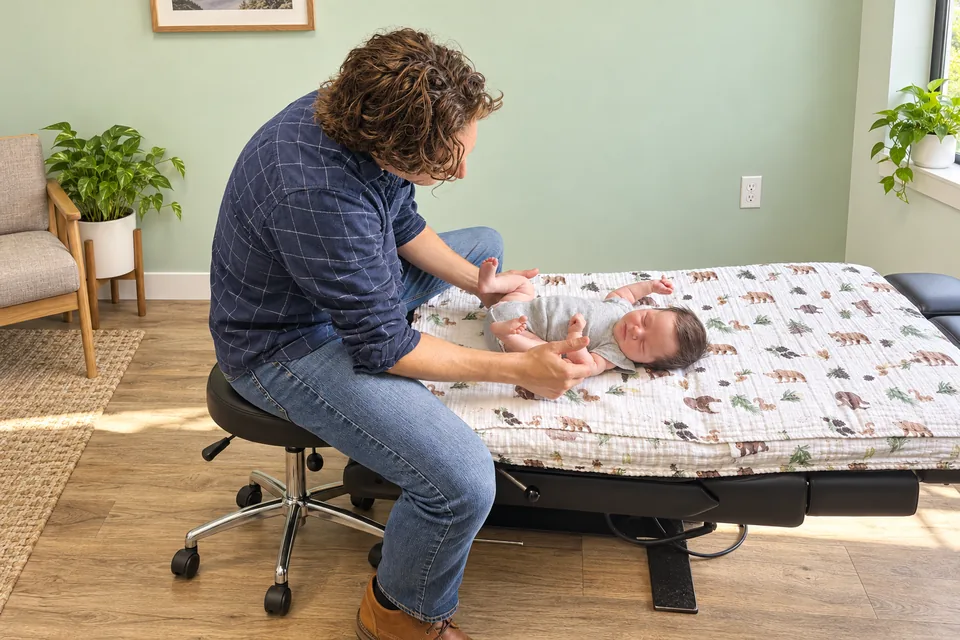
The word adjustment probably conjures an image that doesn't belong anywhere near a days-old baby, something with popping and twisting, force applied to a tiny spine. It's a fair thing to wonder about, and it's one of the most common questions new parents ask us before their baby's first visit. The honest answer is that newborn chiropractic care looks nothing like what happens in an adult session, and understanding what it actually involves usually puts the question to rest.
What Birth Actually Involves for a Baby's Body
Even a straightforward, low-intervention birth is physically demanding for a newborn. A baby's head and neck absorb real pressure as they move through the birth canal, and that pressure increases with a longer labor, a vacuum or forceps delivery, or a C-section. None of this means something went wrong. It means birth, by its nature, puts real physical stress on a small, still-forming spine and nervous system, and that stress can settle in and linger past the moment your baby takes their first breath.
Why the First Weeks Matter So Much
A baby's brain grows at a remarkable pace during the first year, more than doubling in size while forming an enormous number of new neural connections every single day. That rapid growth means the nervous system is unusually responsive during this window, for better or worse. Tension held in the upper neck and spine from birth can interfere with how well a newborn's nervous system settles into its job of coordinating feeding, digestion, sleep, and temperature regulation. Addressing that tension early, while the nervous system is this adaptable, tends to support smoother functioning from the start rather than waiting to see if minor struggles resolve on their own.
What a Newborn Adjustment Actually Feels Like
This is the part that surprises most parents. There is no popping, no cracking, no twisting, nothing close to what an adult adjustment involves. The pressure our doctors use with a newborn is closer to what you'd use to check whether an avocado is ripe, light, precise, and held for a moment rather than a forceful thrust. Most babies stay calm through their adjustment. Many relax visibly or fall asleep during the session. It's a gentle, specific contact aimed at releasing tension in the upper neck and spine, not a miniature version of adult chiropractic.
What We're Actually Looking For
Before any hands-on care, our doctors take a full history of your pregnancy, labor, and delivery, along with anything you've noticed since birth, feeding struggles, unsettled sleep, a preference for turning one direction, excessive fussiness. We also use INSiGHT scanning to get objective data on how your newborn's nervous system is functioning, measuring things like heart rate variability and muscle tension along the spine rather than relying on guesswork. Together, the history and the scan data help us understand exactly where tension is concentrated before we ever touch your baby.
Common Reasons Families Bring Newborns In
- A difficult, prolonged, or heavily assisted delivery
- Trouble latching or nursing comfortably on one or both sides
- A visible head tilt or strong preference for turning one way
- Excessive fussiness, gas, or reflux in the early weeks
- Wanting a baseline check even when things seem to be going well
- A history of a difficult pregnancy or high maternal stress
That last point surprises some families. You don't need a dramatic birth story to benefit from an early check. Plenty of parents simply want a professional look at how their newborn's nervous system is settling in, the same way you'd want a well-baby checkup even when nothing seems wrong.
What Happens After the First Visit
Our doctors build a plan specific to what your baby's exam and scans show, and care is typically spaced out as your baby's nervous system responds, with fewer visits needed over time rather than an open-ended schedule. We also coach parents on simple things to reinforce progress at home, alternating carrying sides, encouraging tummy time in both directions, and positioning during feeds. You're never left wondering what's happening or why. We walk you through our findings at every visit, and we welcome questions at any point along the way, whether that's about what we found, what to expect next, or how a particular visit went.
We also stay in close contact with your pediatrician's guidance rather than working around it. Chiropractic care at this age is meant to complement well-baby checkups, not replace them, and our doctors are glad to share notes with your pediatric team when it's helpful for everyone caring for your baby.
What Parents Often Notice
Every baby is different, and how quickly a family notices change depends on what brought them in and how much tension has built up. That said, parents frequently report an easier time settling for sleep, smoother feeds, less fussiness in the evenings, and a baby who seems more comfortable turning their head both directions. Some notice a shift within the first visit or two. For others, especially after a more difficult birth, the change builds more gradually across several weeks. Either way, our doctors track progress closely so you always know where things stand.
Where to Go From Here
If you're weighing whether to bring your newborn in, we'd rather you ask the question than sit with the uncertainty. You can learn more about how we support newborns and infants, or download our free guide on what the first weeks of nervous system care look like. When you're ready, you can book online with our doctors in Royal Oak, or call us at (248) 616-0900 with any questions before your first visit.